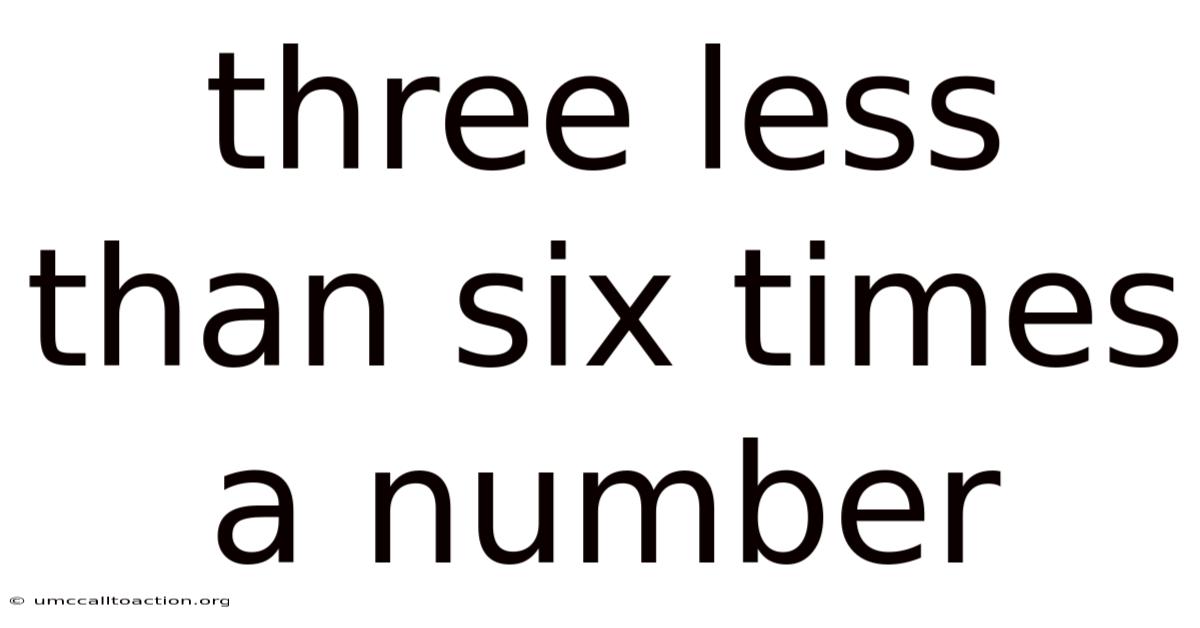
Unraveling the mystery of "three less than six times a number" is a journey into the heart of algebraic expressions, where numbers and operations dance together to create meaningful mathematical statements. This seemingly simple phrase unlocks a world of problem-solving potential, allowing us to translate real-world scenarios into equations and find elegant solutions.
Understanding the Components
Before diving into the complexities, let's break down the phrase "three less than six times a number" into its individual components:
- A number: This is our unknown, the variable we seek to define. It can be represented by any letter, but x is a common choice in algebra.
- Six times a number: This indicates multiplication. We're taking our unknown number and multiplying it by six. This can be written as 6 * x, or more simply, 6x.
- Three less than: This signifies subtraction. We are taking the result of "six times a number" and subtracting three from it.
Translating into an Algebraic Expression
Putting these components together, "three less than six times a number" translates to the algebraic expression:
6x - 3
This expression is a powerful tool. Plus, it allows us to represent a specific relationship between an unknown number and a known quantity (three). We can use this expression to solve problems, create equations, and explore the properties of numbers It's one of those things that adds up..
Exploring the Concept with Examples
To solidify our understanding, let's examine a few examples:
- If the number is 2: 6*(2) - 3 = 12 - 3 = 9. So, three less than six times 2 is 9.
- If the number is 5: 6*(5) - 3 = 30 - 3 = 27. So, three less than six times 5 is 27.
- If the number is -1: 6*(-1) - 3 = -6 - 3 = -9. So, three less than six times -1 is -9.
- If the number is 0: 6*(0) - 3 = 0 - 3 = -3. So, three less than six times 0 is -3.
These examples demonstrate how the value of the expression 6x - 3 changes depending on the value of x. This is a fundamental concept in algebra: expressions represent relationships that can vary based on the input value.
From Expression to Equation: Solving for the Unknown
The power of the expression 6x - 3 truly shines when we use it to create equations. An equation sets two expressions equal to each other. For example:
6x - 3 = 15
Now we have an equation that we can solve to find the value of x. The goal is to isolate x on one side of the equation. Here's how we can solve it:
- Add 3 to both sides: This eliminates the -3 on the left side. 6x - 3 + 3 = 15 + 3 6x = 18
- Divide both sides by 6: This isolates x. 6x / 6 = 18 / 6 x = 3
So, the solution to the equation 6x - 3 = 15 is x = 3. What this tells us is three less than six times 3 is equal to 15. We can verify this: 6*(3) - 3 = 18 - 3 = 15 But it adds up..
Applications in Word Problems
The ability to translate phrases like "three less than six times a number" into algebraic expressions is crucial for solving word problems. Word problems present real-world scenarios that require mathematical reasoning to find a solution. Let's look at some examples:
Example 1:
"John is thinking of a number. Three less than six times his number is 21. What number is John thinking of?
-
Translate: We know "three less than six times a number" is 6x - 3. The problem states this is equal to 21. So, our equation is 6x - 3 = 21.
-
Solve:
- Add 3 to both sides: 6x = 24
- Divide both sides by 6: x = 4
-
Answer: John is thinking of the number 4 It's one of those things that adds up..
Example 2:
"A movie ticket costs $6. Plus, sarah bought some tickets and used a coupon for $3 off her total purchase. If she spent $27, how many tickets did she buy?
-
Translate: Let t represent the number of tickets Sarah bought. The cost of the tickets before the coupon is 6t. After the coupon, the total cost is 6t - 3. We know this is equal to $27. So, our equation is 6t - 3 = 27 Small thing, real impact..
-
Solve:
- Add 3 to both sides: 6t = 30
- Divide both sides by 6: t = 5
-
Answer: Sarah bought 5 tickets Small thing, real impact..
Example 3:
"A rectangle has a length that is three less than six times its width. If the length is 15 inches, what is the width of the rectangle?"
-
Translate: Let w represent the width of the rectangle. The length is "three less than six times the width," which is 6w - 3. We know the length is 15 inches. So, our equation is 6w - 3 = 15.
-
Solve:
- Add 3 to both sides: 6w = 18
- Divide both sides by 6: w = 3
-
Answer: The width of the rectangle is 3 inches Worth keeping that in mind..
These examples highlight the versatility of the expression 6x - 3. By translating word problems into algebraic equations, we can use our mathematical skills to solve for unknown quantities and understand real-world situations.
Exploring Variations and Complexities
While "three less than six times a number" is a relatively simple phrase, it can be incorporated into more complex algebraic expressions and equations. Here are some variations to consider:
- Combining with other operations: We can add, subtract, multiply, or divide the entire expression by other numbers or variables. For example: 2(6x - 3) + 5x.
- Using multiple variables: We can introduce additional variables to create more complex relationships. For example: "three less than six times a number x plus twice another number y," which translates to 6x - 3 + 2y.
- Inequalities: Instead of an equation, we can use an inequality to compare the expression to a value. For example: 6x - 3 > 9 (three less than six times a number is greater than 9). This introduces the concept of a range of possible solutions for x.
The Importance of Order of Operations
When working with algebraic expressions, it's crucial to remember the order of operations (often remembered by the acronym PEMDAS or BODMAS):
- Parentheses / Brackets
- Exponents / Orders
- Multiplication and Division (from left to right)
- Addition and Subtraction (from left to right)
This order ensures that we perform the operations in the correct sequence, leading to accurate results. In the expression 6x - 3, multiplication is performed before subtraction.
Generalizing the Concept: "Less Than"
The phrase "less than" can be tricky because the order is reversed in the algebraic expression. Day to day, "Three less than six times a number" is not the same as 3 - 6x. The phrase "less than" indicates that we are subtracting from something else.
To avoid confusion, it's helpful to rephrase the sentence in your mind. Day to day, "Three less than six times a number" can be rephrased as "six times a number, minus three. " This clarifies the order of the operations Less friction, more output..
Beyond Basic Algebra: Functions
The expression 6x - 3 can also be viewed as a simple linear function. Consider this: a function is a mathematical relationship that assigns a unique output value for each input value. In this case, x is the input, and 6x - 3 is the output Worth keeping that in mind..
We can write this function as f(x) = 6x - 3. This notation emphasizes the relationship between the input x and the output f(x). Understanding this connection is a stepping stone to more advanced mathematical concepts.
Common Mistakes to Avoid
- Incorrect Order: Misinterpreting "less than" and writing 3 - 6x instead of 6x - 3.
- Arithmetic Errors: Making mistakes in basic arithmetic operations (addition, subtraction, multiplication, division).
- Forgetting Order of Operations: Performing subtraction before multiplication.
- Not Distributing Properly: If the expression is within parentheses, remember to distribute any multiplication across all terms inside the parentheses. Here's one way to look at it: 2(6x - 3) = 12x - 6.
- Not Checking Your Answer: After solving an equation, always plug your solution back into the original equation to verify that it is correct.
Practice Problems
To further solidify your understanding, try solving these practice problems:
- What is three less than six times 8?
- If three less than six times a number is 33, what is the number?
- Solve the equation 6x - 3 = 2x + 9.
- A taxi charges a flat fee of $3 plus $6 per mile. If a ride costs $21, how many miles was the ride?
- The perimeter of an equilateral triangle is three less than six times the length of one side. If the perimeter is 15 inches, what is the length of one side?
- Translate the following sentence into an algebraic expression: "Five more than half of the result of three less than six times a number x."
The Broader Significance of Algebraic Thinking
Understanding how to translate phrases into algebraic expressions like "three less than six times a number" is more than just a mathematical exercise. It's a fundamental skill that underpins critical thinking, problem-solving, and logical reasoning. This type of algebraic thinking is essential in many fields, including:
- Science: Formulating equations to describe physical phenomena.
- Engineering: Designing structures and systems.
- Economics: Modeling market behavior.
- Computer Science: Developing algorithms and software.
- Finance: Managing investments and analyzing financial data.
By mastering these basic algebraic concepts, you are equipping yourself with valuable tools that can be applied across a wide range of disciplines Practical, not theoretical..
Conclusion
The phrase "three less than six times a number" is a gateway to a deeper understanding of algebra. Practically speaking, by dissecting its components, translating it into an algebraic expression, and applying it to real-world problems, we open up its power and versatility. Practically speaking, mastering this concept builds a solid foundation for tackling more complex mathematical challenges and developing essential problem-solving skills that are applicable in numerous aspects of life. So, embrace the power of algebra, and continue to explore the fascinating world of mathematical relationships!
Not the most exciting part, but easily the most useful Not complicated — just consistent..
