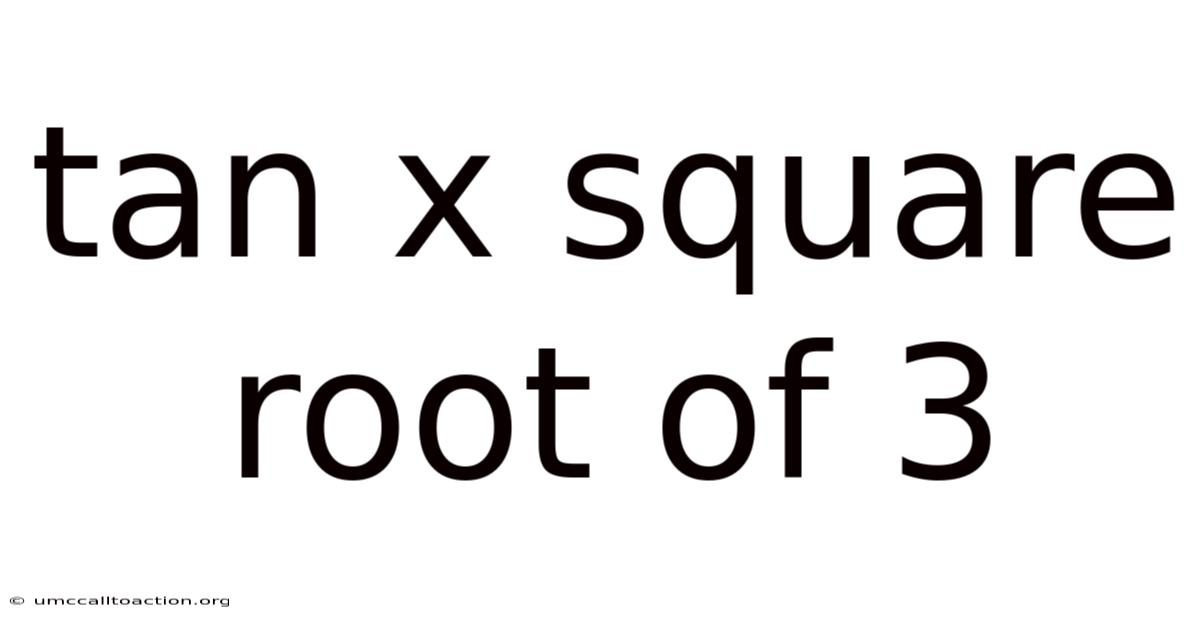
Let's get into the intriguing world of trigonometry and explore the equation tan x = √3. This seemingly simple equation unlocks a wealth of mathematical understanding, touching upon concepts like angles, radian measure, the unit circle, trigonometric functions, and general solutions. We will dissect this equation, understand its solutions, and examine the underlying principles that govern its behavior.
Understanding the Tangent Function
The tangent function, often abbreviated as tan, is one of the fundamental trigonometric functions. In a right-angled triangle, the tangent of an angle is defined as the ratio of the length of the side opposite to the angle to the length of the side adjacent to the angle. Mathematically:
tan θ = Opposite / Adjacent
Where θ represents the angle.
Beyond the right-angled triangle, the tangent function can be defined in terms of the sine and cosine functions:
tan θ = sin θ / cos θ
This definition is particularly useful because it extends the definition of the tangent function to all angles, not just those within a right-angled triangle. Understanding this relationship is crucial for grasping the periodic nature and general solutions of trigonometric equations.
The Unit Circle and Tangent
The unit circle provides a powerful visual representation of trigonometric functions. So it's a circle with a radius of 1 centered at the origin (0, 0) in a Cartesian coordinate system. For any angle θ, the point where the terminal side of the angle intersects the unit circle has coordinates (cos θ, sin θ).
Easier said than done, but still worth knowing.
tan θ = y / x
Using the unit circle, we can visually identify angles that have a specific tangent value. In practice, the tangent function repeats its values every π radians (180 degrees), which is a direct consequence of the periodic nature of both sine and cosine functions. This periodicity is essential for finding all possible solutions to trigonometric equations like tan x = √3. The unit circle allows us to visualize this cyclical behavior and understand why there are infinitely many solutions.
Solving tan x = √3: Finding the Principal Value
To find the solutions to the equation tan x = √3, we first need to find the principal value of x. This is the solution that lies within the interval (-π/2, π/2) or (-90°, 90°).
We're looking for an angle whose tangent is equal to the square root of 3. This leads to recall the special right triangles, particularly the 30-60-90 triangle. Plus, in this triangle, the angle opposite the longer leg has a tangent of √3. This angle is 60 degrees, or π/3 radians.
The official docs gloss over this. That's a mistake.
Because of this, the principal value of x that satisfies tan x = √3 is:
x = π/3 (or 60°)
This is our starting point. On the flip side, due to the periodic nature of the tangent function, this is just one of infinitely many solutions That's the part that actually makes a difference. That alone is useful..
General Solution of tan x = √3
Since the tangent function has a period of π, the general solution can be expressed as:
x = π/3 + nπ
Where n is any integer (n = 0, ±1, ±2, ±3, ...). This formula captures all possible angles that have a tangent equal to √3 Worth knowing..
Let's break down why this works:
- π/3: This is our principal value, the initial angle where tan x = √3.
- nπ: This represents multiples of π (180°). Adding or subtracting multiples of π to the principal value will result in angles that have the same tangent. This is because the tangent function repeats itself every π radians. Geometrically, adding π to an angle corresponds to rotating 180 degrees on the unit circle, which results in the opposite point, where both sine and cosine have their signs flipped, thus maintaining the same ratio (tangent).
So, to find other solutions, we simply plug in different integer values for n:
- If n = 0: x = π/3 + 0π = π/3
- If n = 1: x = π/3 + 1π = 4π/3
- If n = -1: x = π/3 - 1π = -2π/3
- If n = 2: x = π/3 + 2π = 7π/3
- And so on...
Each of these values for x will result in tan x = √3. The general solution elegantly encapsulates all of these solutions in a single formula Nothing fancy..
Solutions within a Specific Interval
Sometimes, we're not interested in all possible solutions, but only those that fall within a specific interval. As an example, we might want to find all solutions to tan x = √3 within the interval [0, 2π].
To do this, we use the general solution and find the values of n that produce solutions within the desired interval.
We know the general solution is x = π/3 + nπ. We want to find the values of n such that:
0 ≤ π/3 + nπ ≤ 2π
Subtract π/3 from all parts of the inequality:
-π/3 ≤ nπ ≤ 5π/3
Divide all parts of the inequality by π:
-1/3 ≤ n ≤ 5/3
Since n must be an integer, the possible values for n are 0 and 1.
- If n = 0: x = π/3 + 0π = π/3
- If n = 1: x = π/3 + 1π = 4π/3
That's why, the solutions to tan x = √3 within the interval [0, 2π] are x = π/3 and x = 4π/3.
Graphical Representation
The solutions to tan x = √3 can also be visualized graphically. If we plot the graph of y = tan x and the horizontal line y = √3, the points where the two graphs intersect represent the solutions to the equation Worth keeping that in mind. Turns out it matters..
The graph of y = tan x has vertical asymptotes at x = π/2 + nπ, where n is an integer. This is because the cosine function is zero at these values, and since tan x = sin x / cos x, the tangent function becomes undefined at these points.
Some disagree here. Fair enough Worth keeping that in mind..
The line y = √3 is a horizontal line intersecting the y-axis at √3. The intersections between the tangent curve and this line will occur at x = π/3 + nπ, confirming our calculated solutions. Graphing provides a visual confirmation of the periodic nature of the tangent function and how the general solution captures all intersection points.
Common Mistakes and How to Avoid Them
Solving trigonometric equations can be tricky, and there are several common mistakes to watch out for:
- Forgetting the General Solution: The most common mistake is finding only the principal value and forgetting to account for the periodic nature of trigonometric functions. Always remember to express the solution in its general form using the period of the function.
- Incorrectly Identifying the Period: Ensure you know the correct period of the trigonometric function you're working with. The period of tan x is π, while the period of sin x and cos x is 2π.
- Dividing by Zero: When manipulating trigonometric equations, be careful not to divide by expressions that could be zero. Here's one way to look at it: when working with tangent, remember that cos x cannot be zero.
- Ignoring Domain Restrictions: Be mindful of any domain restrictions given in the problem. You might find solutions that satisfy the equation but are outside the specified interval.
- Calculator Errors: Make sure your calculator is in the correct mode (degrees or radians) when evaluating trigonometric functions. Double-check your calculations, especially when dealing with special angles.
Applications of tan x = √3
While seemingly abstract, the equation tan x = √3, and trigonometric equations in general, have numerous real-world applications:
- Navigation: Trigonometry is fundamental to navigation, used to determine distances, angles, and positions using landmarks or celestial bodies.
- Physics: Trigonometric functions are used extensively in physics to model oscillations, waves, and projectile motion. The tangent function, in particular, is used to relate angles of elevation and depression to distances.
- Engineering: Engineers use trigonometry in structural analysis, surveying, and electrical engineering. Calculating the slope of a hill, the tension in a cable, or the impedance in an AC circuit all rely on trigonometric principles.
- Computer Graphics: Trigonometry is essential in computer graphics for rotations, scaling, and transformations of objects in 2D and 3D space.
- Astronomy: Astronomers use trigonometry to measure distances to stars and planets, and to understand the movements of celestial objects.
- Surveying: Surveyors use trigonometric principles to measure distances and angles to accurately map land and create property boundaries.
The specific solution to tan x = √3 might not be directly applicable in every scenario, but the underlying principles and problem-solving techniques used to solve it are essential tools in these diverse fields And it works..
Beyond the Basics: More Complex Scenarios
While we've thoroughly explored the equation tan x = √3, you'll want to recognize that trigonometric equations can become much more complex. Here are a few examples of how this basic equation can be extended:
- Transformations: Equations like tan(2x) = √3 or tan(x + π/4) = √3 involve transformations of the angle, requiring adjustments to the solution process.
- Combined Trigonometric Functions: Equations involving a mix of trigonometric functions, such as sin x + cos x = √3, require different techniques like squaring both sides or using trigonometric identities.
- Quadratic Forms: Equations like tan²x - 3 = 0 can be solved by treating them as quadratic equations in tan x.
- Applications with Constraints: Real-world problems often impose additional constraints, such as specific angle ranges or physical limitations, that need to be considered when finding solutions.
- Numerical Methods: For equations that are difficult or impossible to solve analytically, numerical methods like Newton-Raphson can be used to approximate the solutions.
Mastering the fundamentals, like solving tan x = √3, provides a solid foundation for tackling these more complex problems. The key is to break down the problem into smaller steps, use appropriate trigonometric identities, and carefully consider the domain and range of the functions involved.
Conclusion
The equation tan x = √3 serves as an excellent entry point into the world of trigonometry. Day to day, while this specific equation may seem simple, the principles and techniques learned are broadly applicable to a wide range of trigonometric problems and their real-world applications in physics, engineering, navigation, and beyond. By understanding the definition of the tangent function, the unit circle, and the concept of periodicity, we can not only find the principal value but also express the general solution, encompassing all possible solutions. What's more, visualizing the solutions graphically reinforces our understanding and helps to avoid common pitfalls. Now, the ability to solve even a seemingly basic equation like tan x = √3 unlocks a deeper understanding of mathematical concepts and opens doors to more advanced problem-solving in various scientific and engineering disciplines. Remember to always consider the periodic nature of trigonometric functions and express your solutions in the most general form possible to ensure you capture all valid answers.
The official docs gloss over this. That's a mistake Most people skip this — try not to..
